|
Off the Grid
Going off the Grid is a choice of survivalists or remote
homesteaders, but what if it were not a choice? Electricity can be
generated from a Wind or Water mill, or Solar Panels, or even
charging a battery by churning a bike. The Troubled Times
nonprofit explored these issues in depth a decade ago, and the
wisdom they hold then still apply.
The grid may be destroyed and petrol products quickly consumed by
generators and vehicles, and then these too will be idle. What to
do for electricity? Windmills can be constructed
from trash such as from lawn
mower parts.or a ground based Nebraska
windmill.

A ground based Nebraska
windmill is easy to maintain as one does not have to climb a
pole. The Nebraska windmill is set to catch the prevailing winds
and can be easily shuttered for protection during storms.

William Kamkwamba. a 14 year old boy in Africa, demonstrated that
he could build a windmill from scrap to irrigate the gardens in
his village. If this 14 year old boy can build a windmill from
junk parts, so can you.

- Malawi Windmill Boy with Big Fans
October 1, 2009
http://news.bbc.co.uk/2/hi/africa/8257153.stm
- The teenager had a dream of bringing
electricity and running water to his village. When not
helping his family farm maize, he plugged away at his
prototype, working by the light of a paraffin lamp in the
evenings. Neighbours were further perplexed at the youngster
spending so much time scouring rubbish. Mr Kamkwamba knocked
together a turbine from spare bicycle parts, a tractor fan
blade and an old shock absorber, and fashioned blades from
plastic pipes, flattened by being held over a fire. Out went
the paraffin lanterns and in came light bulbs and a circuit
breaker, made from nails and magnets off an old stereo
speaker, and a light switch cobbled together from bicycle
spokes and flip-flop rubber. Then he built a new
windmill, dubbed the Green Machine, which turned a water
pump to irrigate his family's field.
Water wheels can be large or small. One can even be constructed to
twirl during a rain storm if set within a drain pipe. Large
hydroelectric generators are set within dams. Where the slope of a
hill is significant, a High
Head setup can take advantage of the automatic force of the
water. Ram
Pumps can convert the force of water flowing downstream to
push water uphill.

If you live in a hilly area where there are small streams, you can
develop a very adequate power system with very little flow. This is
called a High Head System and it involves as little as a
50 foot drop with only a one gallon per second flow to yield an
average power of a steady 300 watts. This is enough power to drive
your lights and other small appliances. With a battery support, or
flywheel or spring support, you'll be able to develop a really
adequate power system for almost no money and at very little
expense. You want to use the batteries to store power
during the period of little use from 10 PM to 6 AM. You can vary the
output by the diameter of the pipe, the length of the pipe, and the
amount of water you can get into the pipe. It relies on a large
vertical drop rather than a large volume of water. Thus a power
plant near a small stream waterfall, or a contrived water fall.
Hydraulic Ram Pumps are a class of water pumps that use the inertia
of water to pump water to say 10 times the height that water falls.
No power source needed. For example let us say we capture a water
head pressure of 140 ft into an automatic running Hydraulic ram
pump. This might pump 1/12 the volume that enters the pump up the
side of a hill to about 1400 ft to a holding tank above where your
site is. This would run 24 hrs/day for free. Any excess water you
don't use can be converted to electricity. With prevalent rain after
the pole shift one could divert water to your holding tank from
further up the hill. Once the rains stop or slow down, implement the
Hydraulic Ram Pump. The process can be implemented at relatively low
cost. The items don't take up much space. They are simple
construction and easy to repair. The concept of a hydraulic water
mill can be
demonstrated.
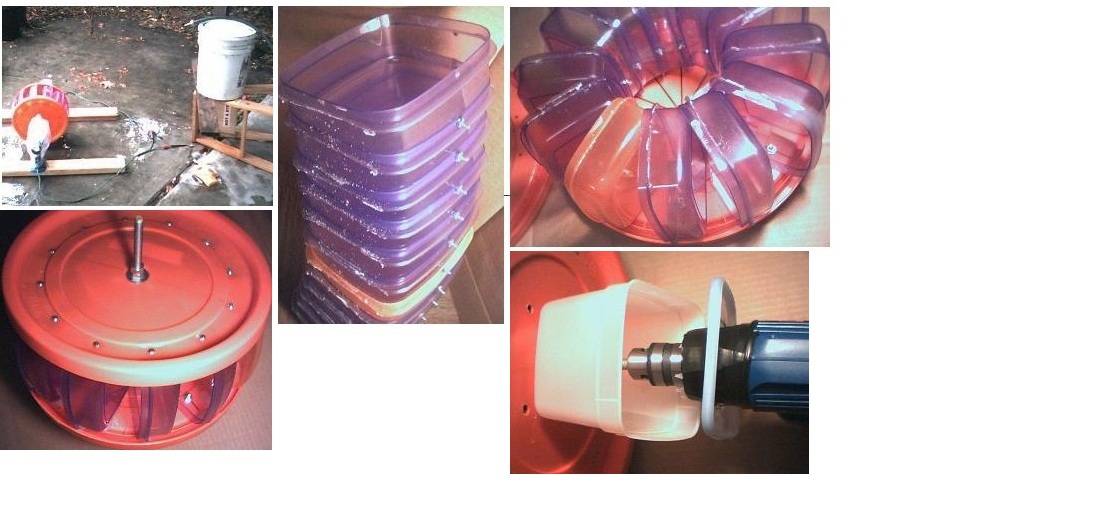
- Water wheel construction: One soon
will get tired of hand cranking and will want to find a
better way. In the near continuous raining condition as is
predicted after a pole shift, water flow in uneven land
conditions creates some interesting opportunities. Even
small areas collecting water will create a significant
amount of run off water flow. All one need do is position a
portable constructed paddle wheel where there is as small as
1 to 1.5 foot water flow drop at a rate of at least about 20
gallons/min and use two cordless drills wired in series as
generators. 12 small plastic containers and several 5 gallon
bucket lids can be used to create a water wheel. Stack one
plastic container on top and nested in the lower one. Drill
in a hole in the middle of one of the longer sides. Use a
#8-32 by .5" long machine screw and nut to fasten them
together.
- The containers are positioned so the
overlap is just barely enough to bolt them together. Use one
container of a different color to aid counting revolutions
in a given stop watch timed run to determine RPM. One can
measure the time it takes for say 20 revolutions to
determine RPM. I used 12 containers (Good Buy Mini Container
distributed by PTS long Beach Ca) and two 5 gallon bucket
lids. These were purchased at a $.99 store for 3/$.99. Once
all 12 are bolted together on the back side then unbolt the
bottom container and place it on top, drilling and bolting
it in. Now take a disk sander and sand off the lips on the
sides that will be bolted to the bucket lid. This makes it
so one has a fl
- Mark and drill holes in one lid then
use this lid as a guide to drill the holes in the other lid.
Add a ring of "silicon-I" sealer and centered the now
circular ring of plastic containers and drill-bolt the
buckets to the lid. Cut a 4.75" long .5" diameter aluminum
or copper tubing put 3/8" washers at each end and glue with
silicone sealer. I used a threaded rod and a couple of nuts
to hold it until the silicone sealer set up. Use this pipe
as a spacer between the lids in the center when assembling
the last side. One water wheel weight is about 3 lbs two is
about 5 lbs. Caution: the 3/8"shaft will bend if nuts are
tighten against a pipe that has a non-square end. Use a pipe
cutter and get a square end.
- The threaded shaft sticks out about
4.5" on each side. Use in this order a garden hose rubber
washer, finder washer, normal washer, lock washer and two
nuts locked together to hold the shaft from slipping on the
5 gallon plastic lid. To keep the water form over time
getting to and rusting the drill chuck (spray with oil at
assembly time) of the drill take a small square shaped
plastic container and drill a hole in the bottom and pie
shape cut the lid. Bend some (3 in my case) of the pies up
and all the rest down. Drill a small drain hole at the
lowest corner so that if any water leaks in, it will drain
out. The pie tabs will be taped to the drill to hold it in
place.
A bike generator can likewise be made from a discarded
bike. All one needs is an alternator, which can be found in
any car and many appliances such as lawn mowers.


The Troubled
Times nonprofit explored battery maintenance and this wisdom
is still pertinent today.
To prepare for the time when rebuilding from junk might be
necessary, gather some of these inexpensive items available now at
stores. Collect clean rain water using gutter pieces. Tack screen in
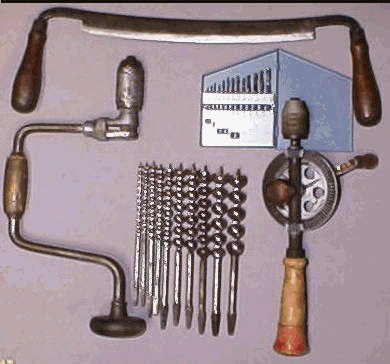
place to keep the mosquitoes out. Gather hand
tools, which can be purchased off the Internet ahead of time
and secure some camping equipment too.
Another piece of junk that might prove to be immensely important
when all your light bulbs burn out. Yes LED bulbs last longer, but
eventually you might be producing electricity but unable to have
light. The answer is Carbon
Arc lamps, used in the past to turn the streets of London as
bright as day. A Carbon Arc is created when direct current is forced
to jump from one piece of carbon to another. Pencil leds are
Carbon/Graphite, and work as the Carbon points. Discarded battery
cores are also Carbon, and are found in the trash.

Accomplished junkmen are sometimes depicted in the movies, for
instance in the movie Waterworld, where the group seeking “dry land”
takes off in an air balloon composed, no doubt, from shark and whale
skins stitched together or from whatever has been dredged up from
the bottom of the ocean. Houseboat living is featured, with
container gardening and fishing and distillation of drinking water.
Houseboat communities are also featured, surviving on methane gas.
All from junk.


|